

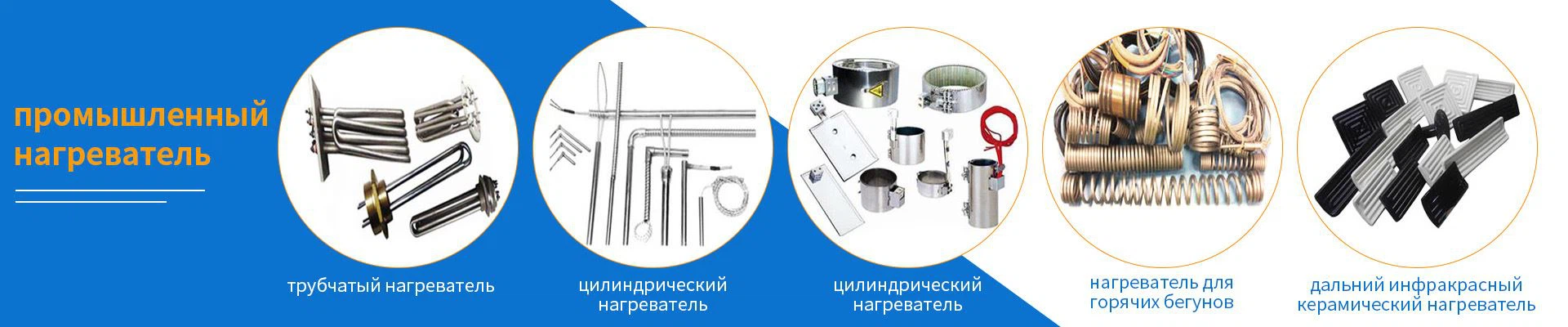
Каковы распространенные неисправности керамических инфракрасных обогревателей?
Common faults of ceramic infrared heaters are as follows:
Poor heating effect
Aging of heating elements: After long-term use, the resistance value of the heating element will change, resulting in a decrease in heat generation. For example, the heating wire will gradually become thinner, the resistance will increase, the power will decrease, and the heating effect of the heater will deteriorate if it works at high temperature for a long time.
Unstable power supply voltage: If the power supply voltage fluctuates greatly and is lower than the rated voltage of the heater, the actual power of the heater will be reduced, affecting the heating effect. For example, when the voltage drops by 10%, the power may drop by about 20%.
Damaged or dirty reflector: The function of the reflector is to reflect infrared light onto the heated object to improve the heating efficiency. If the reflector is damaged and cannot effectively reflect light, or there is a lot of dust, oil, etc. on the surface, the reflectivity will be reduced, the heat will be lost, and the heating effect will be affected.
No heat
Power cord is broken: The power cord may be broken due to external force pulling, aging, etc., resulting in the inability of the current to reach the heater. For example, in daily use, if the power cord is often bent, the internal wire will break.
Fuse blown: When an overload, short circuit or other fault occurs in the circuit, the fuse will blow, cut off the circuit and protect the equipment. For example, if the heating element inside the heater is short-circuited, the current will increase instantly, causing the fuse to blow.
Thermostat failure: The thermostat is used to control the temperature of the heater. If the thermostat fails, the heater may not start normally. If the contacts of the thermostat are sticky and the circuit cannot be disconnected, or the temperature sensing element is damaged and cannot accurately sense the temperature, the heater will not heat up.
Leakage
Insulation damage: The insulation material of the heater may be damaged due to long-term heat, moisture, aging, etc., causing the live parts to contact the non-live parts such as the outer shell, resulting in leakage. For example, the insulating material will gradually become brittle and lose its insulating properties at high temperatures.
Loose terminals: If the wires at the terminals are loose, sparks will be generated, burning the insulation layer, and then causing leakage. At the same time, loose terminals will also increase contact resistance, increase local temperature, and accelerate insulation aging.
Damaged shell: If the shell of the heater is damaged by external impact, the live parts inside may be exposed and come into contact with the human body, causing leakage accidents.
Inaccurate temperature control
Failure of the thermostat: The temperature sensing element of the thermostat may fail and fail to accurately measure the temperature, or there may be problems with the control circuit, resulting in failure to control according to the set temperature. For example, the thermal response time of the temperature sensing element becomes longer, which will cause lag in temperature control.
Uneven distribution of heating elements: If the heating elements inside the heater are unevenly distributed, the temperature difference in different parts will be large, affecting the overall temperature control accuracy.
The above are common faults of ceramic infrared heaters. In actual use, they can be checked and repaired according to the specific situation. For some complex faults, it is recommended to be handled by professionals to ensure safety and repair results.


